

Strengths and Shortcomings of School Education in India | An Honest Parent’s Guide
India has one of the world’s largest and oldest education systems. So why do so many parents and students feel it isn’t working well enough? Let’s talk about both sides — and where things are genuinely improving.
If you’ve ever sat across from your child struggling with rote-memorised answers the night before an exam, or watched a bright student lose her love for learning somewhere between Class 6 and Class 10 — you’ve already sensed that something in our school education system isn’t quite right.
But it would be equally unfair to dismiss the whole picture. India’s school education system has real strengths, a rich legacy, and is going through genuine reform. Understanding both sides — the strengths and shortcomings of school education in India — helps parents make more informed decisions about where and how their children learn.
Let’s take an honest look.
A Quick Context: The Scale of Indian School Education
The numbers alone tell a remarkable story. According to the UDISE+ 2023–24 Report by the Ministry of Education, India’s school education system serves 24.8 crore students across 14.72 lakh schools with nearly 98 lakh teachers. Government schools account for 69% of all schools, enrolling half of the country’s students.
This scale is both a strength and a challenge. Delivering consistent, quality education across mountains, villages, tier-1 cities, and remote tribal areas is an enormous task that few countries have had to manage at this size.
Strengths of School Education in India
1. A Strong Academic Foundation
One thing India’s education system genuinely does well is building rigorous academic fundamentals — particularly in mathematics and science. Indian students consistently perform well in international competitive exams, and Indian graduates are sought after in global universities and corporations alike.
This is not accidental. The emphasis on conceptual depth in subjects like mathematics, physics, and chemistry — even when teaching methods are imperfect — produces students with solid analytical foundations. That’s a real strength worth acknowledging.
2. The Gurukul Legacy: Values-Centred Learning
India’s educational roots go back thousands of years to the Gurukul system, where students lived and learned with their teachers (Gurus) in residential settings that combined knowledge, discipline, ethics, and character formation. The Gurukuls of ancient India were the world’s first residential schools, and the learning that happened there was holistic — covering philosophy, mathematics, medicine, arts, and practical life skills in equal measure.
This legacy isn’t just history. The best schools in India today — particularly good residential schools — draw deeply from this tradition. The idea that education should shape the whole person, not just fill her with information, remains one of Indian education’s most valuable philosophical inheritances.
3. Growing Access Through Government Initiatives
India has made extraordinary strides in expanding access to education. The Right to Education Act (2009), Sarva Shiksha Abhiyan, and the National Education Policy (NEP) 2020 have driven literacy rates from roughly 12% at independence to over 74% today — with the World Bank’s data placing adult literacy (ages 15+) at 81.7% in 2023.
Schemes like Beti Bachao Beti Padhao have specifically targeted girl child education — one of the most significant shifts in the country’s educational story. According to the UDISE+ 2024–25 report, girls now comprise 48.4% of total school enrolment, with female teachers making up 54.2% of the teaching workforce — both record highs.
4. A Rich Ecosystem of Diverse Schools
India is home to some of the world’s finest schools — many of them located in cities like Dehradun, which has been India’s boarding school capital for over a century. From CBSE to IB to Cambridge CAIE, parents today have a genuinely rich ecosystem of curricula and school types to choose from.
The quality gap between the best and worst schools is large — but at the top end, Indian schools offer world-class education, extraordinary co-curricular programmes, and alumni networks that connect students to opportunities globally.
5. Deep Respect for Teachers and the Learning Process
Indian culture places the teacher — the Guru — at the centre of the educational relationship with a reverence that is almost without parallel. This cultural respect for learning creates a classroom environment where students are generally attentive, teachers are respected, and the pursuit of knowledge is held in high regard.
This isn’t universal, but it remains a distinctive strength of the Indian educational ethos.
Shortcomings of School Education in India
Now, let’s be equally honest about where the system falls short — because these gaps are real, and understanding them helps parents look for schools that are actively working to bridge them.
1. Rote Learning Over Critical Thinking
This is probably the most widely criticised shortcoming of Indian school education, and for good reason. For decades, the system has been structured around memorisation — recall what you’ve been taught, reproduce it in an exam, get marks, move on.
The result? Students who can recite facts but struggle to apply them. Graduates who score well in theory but feel lost in the workplace. Young people who have spent 12 years learning answers, but not how to ask better questions.
The problem isn’t the students. It’s a system that has historically valued exam performance above genuine understanding.
2. Exam-Centric Pressure and Mental Health
The numbers here are striking — and sobering. A survey by NCERT’s Manodarpan initiative, conducted across 3.79 lakh students in Classes 6–12, found that around 80% of students in Classes 9–12 cited exams and results as their primary source of anxiety. That’s not a fringe concern — that’s the majority of secondary school students in India, anxious about their academic performance on any given school day.
Board exams carry enormous social, familial, and academic weight. The pressure this creates is very real. Anxiety, stress, sleep deprivation, and in some cases, mental health crises, are not uncommon among students in Class 10 and Class 12.
A system that treats a single high-stakes examination as the primary measure of a child’s worth and intelligence is doing that child a disservice. Education should open children up — to curiosity, creativity, and confidence. When it instead closes them down through fear of failure, something has gone fundamentally wrong.
3. Shortage of Well-Trained, Motivated Teachers
A school is only as good as its teachers. And one of the most persistent shortcomings in Indian school education — particularly in government and underfunded private schools — is a shortage of well-trained, consistently motivated teachers.
The UDISE+ 2024–25 report notes that only 85% of secondary school teachers are formally trained, dropping to 78% at the higher secondary level. Teacher training in India has historically been underprioritised. Many teachers enter classrooms equipped to deliver lessons, but not necessarily to inspire, diagnose learning difficulties, adapt to individual students, or nurture emotional wellbeing alongside academics.
The NEP 2020 has recognised this and includes comprehensive teacher development frameworks — but implementation remains the challenge.
4. The Urban-Rural Divide
The quality gap between urban and rural schools in India is stark. While a private school in Delhi or Dehradun might have smart classrooms, qualified counsellors, and internationally recognised curricula, government schools in remote districts often lack basic infrastructure. The UDISE+ 2023–24 data shows that only 53.9% of schools have internet access, and just 57.2% have functional computers — numbers that vary dramatically between states.
This divide in access to quality education is one of the most significant equity challenges India faces. COVID-19 made it worse — digital learning accelerated in cities while rural students were often entirely cut off from their education for months.
5. Lack of Practical and Experiential Learning
Indian classrooms are still overwhelmingly theory-driven. Students read about experiments rather than conduct them, study about the world rather than engage with it, and learn about leadership rather than practise it.
Hands-on learning, project-based education, design thinking, and experiential curricula remain the exception rather than the norm in most Indian schools. The best schools — particularly boarding schools — are changing this, but the average classroom hasn’t caught up.
6. Limited Focus on Co-Curricular Development
For too many Indian schools, sports, arts, music, and extracurricular activities are treated as extras — luxuries to be accommodated after the “real” business of academics is done. This is a fundamental misunderstanding of how children develop.
Research tells a different story. A study published in IRA International Journal of Education found that students who participated in co-curricular activities — whether sports, literary clubs, or performing arts — consistently showed higher academic performance and stronger personality development than those who didn’t. Co-curricular development isn’t a distraction from academic performance — it’s the soil in which academic performance grows.
7. Insufficient Attention to Girls’ Education and Empowerment
Despite progress, many girls in India still face structural barriers to quality education — from early dropout due to socio-economic pressures, to schools that don’t provide safe, supportive environments for young women to thrive and lead.
The specific educational needs of girls — including safe spaces, female mentors, freedom to pursue STEM and leadership, and an ethos of genuine empowerment — are still not universally prioritised in Indian school education.
What Does Good Look Like? What Parents Should Be Looking For
Understanding the strengths and shortcomings of India’s school education system isn’t just an academic exercise — it’s a framework for choosing better.
Here’s what separates genuinely excellent schools from average ones in today’s India:
A shift from rote to conceptual learning — where students understand, apply, and discuss ideas rather than merely reproduce them
Robust teacher training and pastoral care — where teachers are mentors, not just instructors, and student wellbeing is taken seriously
Rich co-curricular programmes — sports, performing arts, clubs, debate, and community service as core parts of the school day, not afterthoughts
An empowerment-focused culture for girls — particularly important if you’re choosing a girls’ school, where the question isn’t just academic performance but whether your daughter will leave stronger, more confident, and more ready to lead
A learning environment that reduces exam-anxiety — through continuous assessment, mentorship, and a school culture that celebrates effort and growth alongside achievement
These qualities are not easy to find — but they do exist, particularly in well-run residential schools where the environment itself can be designed holistically.
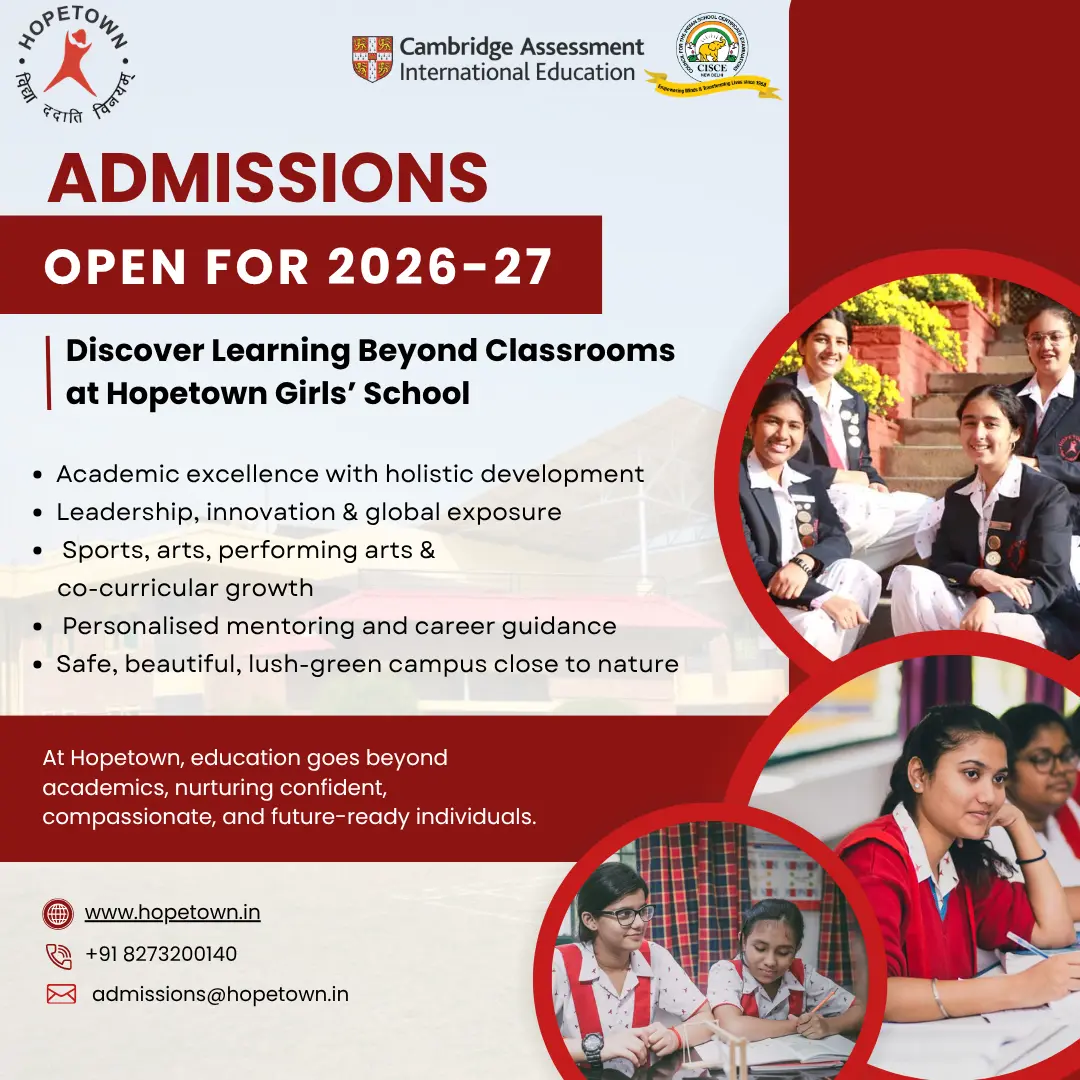
Top Girls Boarding Schools in Dehradun like Hopetown represent this philosophy in practice — where the strengths of India’s educational tradition are preserved (discipline, academic rigour, deep teacher-student bonds) while its shortcomings are actively addressed through modern pedagogy, genuine co-curricular investment, and a culture that puts young women’s growth — intellectual, physical, emotional — at the centre of everything.

Can Technology and AI Fix the Indian Education System?
A question that’s come up a lot recently: can AI replace teachers and solve the problems in India’s education system?
The short answer is no — not replace, but meaningfully support. AI and technology can personalise learning, give students immediate feedback, identify learning gaps earlier, and make high-quality educational content accessible in remote areas. These are genuinely exciting possibilities, and the NEP 2020 has made digital integration a key priority.
But technology cannot replicate what a great teacher does — build trust, notice a student’s distress, ignite curiosity through a conversation, or hold a struggling child to a higher standard with warmth and belief. The human relationship at the heart of education is irreplaceable.
What technology can do is free up great teachers to do more of what only they can do, by handling the mechanical and administrative parts of learning. That’s the right way to think about it.
Frequently Asked Questions
What are the strengths of the Indian education system?
India’s school education system has several genuine strengths: a rigorous academic foundation especially in STEM subjects, a deep cultural reverence for learning and teachers, growing government investment in access and equity, a diverse ecosystem of school types and curricula, and a long tradition of values-centred education rooted in the Gurukul philosophy.
What are the main shortcomings in the education sector of India?
The main shortcomings include over-reliance on rote learning and memorisation, extreme exam-centric pressure that harms student mental health, a shortage of well-trained teachers, a sharp urban-rural quality divide, limited practical and experiential learning, insufficient co-curricular development, and inadequate focus on holistic empowerment — especially for girls.
What do you think are the strengths and weaknesses of the education system?
The strength of the Indian education system lies in its scale, its academic depth, and its cultural respect for learning. Its weaknesses lie in outdated pedagogy, inequitable access, and a system that has historically prioritised marks over meaning. The best schools in India today are working to preserve the former while reforming the latter.
What are some strengths in education that Indian schools demonstrate?
Strong mathematical and scientific foundations, dedicated teacher-student relationships, a tradition of residential education that builds character and independence, and increasingly, schools that integrate international curricula with Indian values — producing students who are both globally competitive and rooted in their own identity.
What are the strengths and weaknesses of a school in India today?
A strong Indian school today would demonstrate: conceptual teaching over rote learning, active co-curricular programmes, robust pastoral care, and a culture of genuine student empowerment. A weak one would be characterised by exam-focused teaching, untrained staff, poor infrastructure, and an environment where students pass exams but don’t actually grow.
What are the major strengths of India in terms of education?
India produces the world’s largest number of STEM graduates, has a literacy rate that has grown dramatically since independence, and is home to globally reputed institutions from IITs to IIMs. According to the World Bank, adult literacy crossed 81% in 2023 — a remarkable climb from around 40% in the early 1980s.
The Bottom Line
India’s school education system is not broken — but it is uneven, and in many places, still catching up with what students actually need.
The strengths are real: the academic rigour, the cultural reverence for learning, the growing access, and the pockets of genuine excellence that exist across the country. The shortcomings are equally real: the rote learning culture, the exam pressure, the teacher training gaps, and the inequalities between urban and rural, rich and poor, boys’ education and girls’ education.
For parents making school decisions today, understanding this landscape is essential. The best choice isn’t necessarily the most expensive school, or the one with the most famous name — it’s the one that has genuinely grappled with these shortcomings and built an environment where your child can learn deeply, grow fully, and emerge confident and ready.
That kind of school exists. It just requires knowing what to look for.
Hopetown Girls’ School, Dehradun, is built on exactly this understanding — preserving what is finest in India’s educational tradition while building the kind of modern, holistic, girl-focused environment that the next generation of young women deserves. Discover Hopetown →
Hopetown Girls’ School is proud to introduce the prestigious Cambridge A Level Program