
Should I Send My Daughter to Boarding School? A Parent’s Honest Guide
Making one of the most important decisions of your child’s life doesn’t have to feel overwhelming. Let’s talk it through — together.
If you’ve found yourself lying awake at night asking, “Should I send my daughter to boarding school?” — you’re not alone. Thousands of parents wrestle with this question every year. It’s not just a school decision; it feels like a life decision. And in many ways, it is.
This guide is here to help you cut through the noise, understand what boarding school truly offers your daughter, address your real concerns, and help you figure out whether it’s the right fit for her — and for your family.
What Does Boarding School Actually Mean for Your Daughter?
At its core, a girls’ boarding school is a residential educational institution where your daughter lives, studies, and grows — all in one nurturing environment. She attends classes during the day, participates in sports and extracurricular activities in the evenings, and lives in supervised dormitories with peers her age.
But it’s so much more than just “school with a hostel.” The best girls’ boarding schools create an ecosystem where academic excellence, emotional development, and character building happen simultaneously — round the clock.
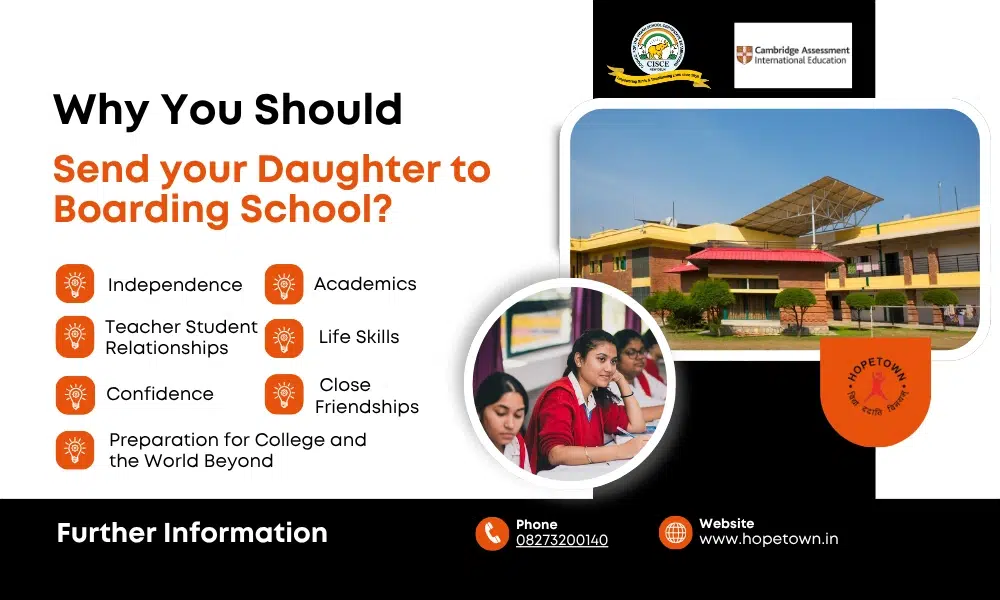
7 Reasons Why Sending Your Daughter to Boarding School Could Be the Best Decision You Make
1. She Learns Independence — the Real Kind
There’s a difference between a child who knows she can manage on her own and one who has actually done it. Boarding school gives your daughter the latter.
From managing her timetable to keeping her dorm room tidy, resolving a conflict with a roommate, or figuring out how to balance prep time with sports practice — she develops self-reliance that no classroom lesson can teach. The kind of independence she builds here becomes the foundation for everything she does in college and adult life.
Schools like Hopetown are intentional about this. The structured daily routine — from morning assembly to study hours — is designed so that girls learn to own their day, not just move through it.
2. Academic Focus Like Nowhere Else
Here’s something parents notice quickly: boarding school students tend to be remarkably focused. Why? Because the environment is designed for it.
Dedicated study halls, supervised prep periods, and small class sizes mean your daughter isn’t fighting for a teacher’s attention. There are fewer distractions, more structured study time, and a peer culture where academic achievement is genuinely respected. The result? Deeper learning, better grades, and a stronger foundation for competitive entrance exams and college admissions.
3. Life Skills That Last a Lifetime
Ask any boarding school alumna what she values most from her school years, and chances are it won’t just be her marks. It’ll be the time management, the problem-solving, the ability to navigate diverse personalities, and the confidence to speak up in a room full of strangers.
Boarding school is where girls learn to do their own laundry, manage their own money, prioritize responsibilities, and ask for help when they need it — all in a safe, supervised setting. These are the life skills that actually matter when she steps into the world.
4. Closer Teacher-Student Relationships
In a traditional day school, a teacher sees your daughter for 45 minutes and moves on to the next class. In a boarding school, teachers often live on campus, eat in the same dining halls, and are genuinely invested in each student’s growth.
This proximity creates something rare: mentorship. Your daughter doesn’t just learn from her teachers — she builds relationships with them. These mentors notice when she’s struggling, celebrate when she excels, and guide her in ways that go far beyond academics.
5. A Girls-Only Environment That Builds Confidence
Research consistently shows that girls in single-sex schools are more likely to participate actively in class, take on leadership roles, and pursue subjects like STEM without hesitation. When there’s no social pressure to shrink, girls step forward.
A girls’ boarding school removes a significant layer of social distraction and replaces it with an environment where every leadership position, every sport, every achievement belongs to a girl. The confidence that grows from this experience is visible and lasting.
At Hopetown, a dedicated girls’ boarding school set in the foothills of Dehradun, this philosophy is woven into everything — from the way classes are run to the way girls are encouraged to lead, question, and pursue their passions without limits.
6. Friendships That Become Family
Ask a boarding school alumna who her closest friends are. Almost always, the answer traces back to her hostel corridor. When you live, eat, study, and laugh with the same people for years, you form bonds that are genuinely deep.
Your daughter will be surrounded by peers from across the country — different backgrounds, cultures, and perspectives — all growing up together. This exposure builds empathy, cultural awareness, and communication skills that set her apart for the rest of her life.
7. Preparation for College and the World Beyond
Boarding school is, in many ways, a dress rehearsal for college — but with safety nets still firmly in place. Your daughter learns to manage her own schedule, live independently, navigate conflict, and pursue goals without you doing it for her. By the time she steps into university, she’s already done the hard part.
Studies consistently show that boarding school graduates feel significantly more confident and prepared for college life than their day school peers. And that confidence translates into results.
Addressing Your Real Concerns
Let’s be honest — if this decision were easy, you wouldn’t still be reading. Here are the concerns most parents actually have.
“Is my daughter too young for boarding school?”
This is one of the most common questions parents ask. Most educators and child development experts recommend waiting until a child is at least 11–13 years old before boarding, as this is when they have developed enough emotional and social readiness to thrive away from home.
Early secondary school — Class 6 onwards — is generally considered the ideal entry point. That said, every child is different. If your daughter is emotionally mature, socially confident, and genuinely curious about the experience, she may be ready even at 10–11. If she’s still deeply dependent on daily parental routine, a year or two more at home won’t hurt.
“Will she miss home too much?”
Yes — at first. And that’s actually okay. Missing home is part of growing up. The question is whether the school has systems in place to support her through it. Regular calls home, well-trained house staff, peer mentorship programmes, and a warm dormitory culture all make a significant difference. What most parents find surprising is how quickly their daughters settle in — and how proud they are of themselves once they do.
Boarding School vs Day School: Which Is Better?
There’s no universal answer — it depends on your daughter and your family’s circumstances. Here’s a quick way to think about it:
Boarding school tends to be the better fit when:
- You want a structured, distraction-free academic environment
- Your daughter needs a stronger peer community and social exposure
- You’re preparing her for competitive college admissions
- Distance, work demands, or other family circumstances make daily supervision difficult
- Your daughter is independent-minded and ready for a challenge
Day school tends to work better when:
- Your child is very young or emotionally sensitive
- Strong daily family interaction is a priority
- Local schools offer exceptional programmes that meet her needs
The honest truth? Many parents who were initially unsure about boarding school look back on the decision as one of the best they made for their daughter.
What to Look for in a Good Girls’ Boarding School
Not all boarding schools are equal. Here’s what separates genuinely excellent girls’ boarding schools from average ones:
- Strong academic track record with results in board exams and competitive tests
- A genuine focus on pastoral care — how the school supports students emotionally, not just academically
- Rich co-curricular opportunities — sports, performing arts, debate, science clubs
- A safe, secure campus with clear child protection policies
- A girls-empowerment ethos — not just marketing language, but visible in leadership, curriculum, and culture
- Transparent communication with parents — regular updates, accessible staff, open-door policies
Schools like Hopetown, nestled in the serene hills of Dehradun, bring together all of these qualities. With a nurturing residential environment, a focus on building young women of substance, and a setting that naturally encourages focus and growth, it exemplifies what a purpose-built girls’ boarding school can look like.
Frequently Asked Questions
Is it a good idea to send your child to boarding school?
For the right child and family, absolutely yes. Boarding school builds independence, academic rigour, social skills, and life readiness in ways that are difficult to replicate in a day school environment. The key is choosing the right school and ensuring your daughter is emotionally ready for the experience.
What is the best age to send a daughter to boarding school?
Most educators recommend Class 6 onwards, typically between 11 and 13 years of age. This is when children have developed enough independence and social maturity to thrive in a residential setting. However, readiness varies by child — some are ready earlier, some benefit from waiting a year or two more.
What are the disadvantages of boarding school?
The main challenges include homesickness (especially initially), reduced daily family interaction, higher costs, and less direct parental oversight. These are real trade-offs that every family needs to weigh against the significant benefits boarding offers.
Why do parents send their daughters to boarding school?
Reasons vary widely — from wanting a distraction-free academic environment and stronger peer community, to preparing their daughter for college life, to work or relocation circumstances. Many parents also choose boarding school specifically for the character-building and independence it fosters.
Which is better — boarding school or day school?
Neither is universally “better.” Boarding school excels at developing independence, academic focus, life skills, and deep peer connections. Day school offers more daily family contact and lower costs. The right choice depends on your daughter’s temperament, maturity, and your family’s goals.
What are the negative effects of boarding school?
If not well-chosen, boarding school can lead to homesickness, social anxiety, or a feeling of disconnect from family. This is why pastoral care, a warm dormitory culture, and strong communication between school and parents are non-negotiable when selecting a school.
What is the right boarding school for girls in India?
Look for schools with a strong academic reputation, a genuine girls-empowerment culture, excellent facilities, certified pastoral care programmes, and a track record of alumni success. Dehradun, known as the boarding school capital of India, is home to some of the finest girls’ residential schools in the country.
The Bottom Line
Asking “Should I send my daughter to boarding school?” is really asking: What kind of woman do I want her to become?
If your answer involves a young woman who is independent, academically strong, emotionally resilient, socially confident, and ready to lead — then a great girls’ boarding school isn’t just a good option. It might be exactly what she needs.
Take the time to visit schools, speak to students and alumni, ask hard questions, and trust your instincts. Your daughter’s potential is remarkable — the right environment will bring it out.
Hopetown Girls’ School is proud to introduce the prestigious Cambridge A Level Program